
Titanium CNC Machining Services
JeaSnn manufactures custom titanium parts from customer drawings and CAD files, supporting prototypes and production quantities. Part geometry, dimensional requirements, material grade, and machining requirements are reviewed for each project before production.


Titanium for CNC Machined Parts
Titanium should be selected according to the actual functional and manufacturing requirements of the part. Before production, consider whether titanium is necessary, which grade is specified, how the part geometry affects machining, and what requirements must be controlled on the finished part.
Material Necessity
Titanium can add significant material and machining cost. Confirm that the operating and performance requirements of the part justify its use rather than selecting it where a more conventional material would be sufficient.
Grade & Material Condition
Different titanium grades can have different properties and machining requirements. Specify the grade, applicable material standard, and required condition clearly on the drawing before sourcing and production.
Part Geometry
Thin walls, deep pockets, difficult tool access, and high material removal can make titanium parts more demanding to machine. These features should be reviewed early when determining the machining approach.
Critical Part Requirements
Identify critical dimensions, mating features, threads, and surface requirements on the drawing. This helps machining and inspection focus on the features that directly affect fit and function.
Titanium Grades for CNC Machining
Titanium is available in different commercially pure and alloy grades, each with different mechanical properties and application considerations. The grades below are commonly specified for machined titanium parts and can be used as an initial material selection reference. Material availability and the exact specification should be confirmed for each project before production.
| Grade | Key Characteristics | Machining Considerations | Consider When |
|---|---|---|---|
| Grade 2 | Commercially pure titanium with good ductility and corrosion resistance | Lower strength than Ti-6Al-4V; machining still requires appropriate control of cutting heat and tooling | The part requires commercially pure titanium and does not need the higher strength of titanium alloys |
| Grade 5 (Ti-6Al-4V) | Widely used α-β titanium alloy with high strength and a strong strength-to-weight balance | More demanding to machine than many conventional metals; cutting conditions and heat control are important | Higher mechanical strength is required and the drawing specifies Ti-6Al-4V |
| Grade 9 (Ti-3Al-2.5V) | Medium-strength α-β alloy offering a balance between commercially pure titanium and Grade 5 | Confirm material form, condition, and required mechanical properties before machining | The drawing specifies Grade 9 or Ti-3Al-2.5V and its property range suits the part |
| Grade 23 (Ti-6Al-4V ELI) | Extra-low-interstitial version of Ti-6Al-4V with improved fracture toughness and ductility in relevant conditions | Material specification and certification requirements should be clearly defined before sourcing and machining | The drawing specifically requires Ti-6Al-4V ELI and its controlled interstitial content or associated properties |
Titanium Parts We Machine
See examples of titanium parts machined by JeaSnn for different designs and functional requirements.


Surface Finishes for Titanium Parts
Different surface treatments can be applied to titanium parts depending on the required appearance, surface texture, friction, wear, and other functional requirements. The appropriate finish should be selected according to the part design and service conditions.
Anodizing
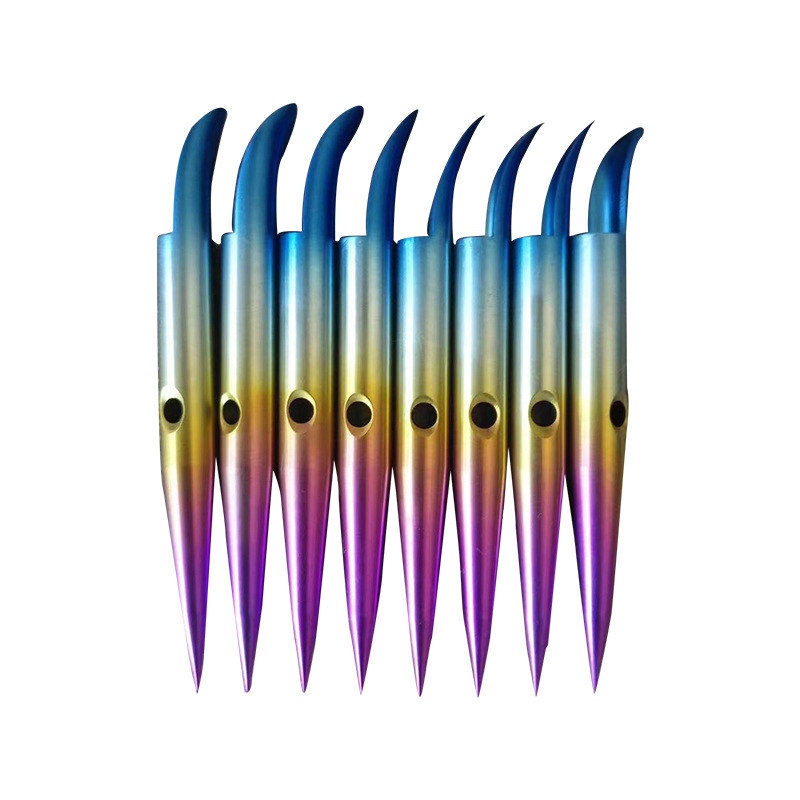
Controls the oxide layer on titanium to produce distinctive interference colors, useful for color identification or specified appearance without conventional paint.
Polishing
Reduces machining marks and surface roughness to create a smoother titanium surface where a finer surface finish is required.
Sandblasting
Creates a consistent matte texture on titanium parts and reduces visible differences between machined surface areas.
PVD Coating
Applies a thin deposited coating to titanium parts for specified surface characteristics or appearance, depending on the selected coating system.
DLC Coating
Provides a hard, low-friction surface coating for titanium parts subject to sliding contact, friction, or wear.
Brushing
Creates a controlled directional grain on titanium surfaces where a consistent linear texture is required.
Applications of Titanium Machined Parts
Titanium machined parts are used in applications where specific material properties are required, including high strength relative to weight, corrosion resistance, and performance under demanding service conditions. Typical applications can be found in aerospace, medical equipment, automotive, marine, and other specialized mechanical systems, depending on the titanium grade and part requirements.




Titanium CNC Machining FAQ
What tolerances can be achieved on CNC machined titanium parts?
Tolerance depends on part geometry, feature size, wall thickness, and machining setup. Published industry capabilities range from around ±0.125 mm to ±0.005 mm under different conditions. Critical tolerances should be specified on the drawing for project-specific review.
Why is titanium difficult to CNC machine?
Titanium has low thermal conductivity, so cutting heat tends to remain concentrated near the cutting zone. Proper tooling, cutting parameters, cooling, and chip evacuation are important for controlling heat and tool wear.
How do I choose between Grade 2 and Grade 5 titanium?
Grade 2 is commercially pure titanium and is typically considered when corrosion resistance and ductility are important. Grade 5 (Ti-6Al-4V) provides substantially higher mechanical strength and is selected when the part requires greater load-bearing performance.
Do thin walls and deep pockets make titanium parts more difficult to machine?
Yes. Thin walls can deflect or vibrate during machining, while deep pockets can increase tool overhang and make chip evacuation and heat control more difficult. These features should be reviewed before production.
What information is needed for a titanium CNC machining quote?
Provide a 3D CAD file and/or 2D drawing, titanium grade, quantity, tolerances, surface finish, and inspection requirements. Any required material standard or material condition should also be specified.
Cost-efficient Machined Parts at Any Quantity
Upload your CAD file and get a quote with free DFM feedback within 24 hours. From rapid prototypes to mass production — flexible volumes to fit your project.